Rechercher dans ce blog

Thursday, October 29, 2020

There’s no place like the perfectly sized home for the mighty mantis shrimp - Ars Technica

jumi.indah.link
"Nice burrow you have there. I want it." Patrick Green of the University of Exeter filmed this fight between mantis shrimp.

Size matters to the small-but-mighty mantis shrimp, which show a marked preference for burrows in coral rubble with volumes that closely match their own body size or are just a bit larger—in other words, large enough to accommodate their body, but small enough that they can defend the entrance. But according to a new paper published in the journal Animal Behavior, sometimes a mantis shrimp will compromise. If a burrow is already occupied and is close to the ideal size, or a bit smaller, the mantis shrimp will fight longer and harder for that burrow—and be more likely to win the contest.

As we previously reported, mantis shrimp come in many different varieties: there are some 450 known species. But they can generally be grouped into two types: those that stab their prey with spear-like appendages ("spearers") and those that smash their prey ("smashers") with large, rounded, and hammer-like claws ("raptorial appendages"). Those strikes are so fast—as much as 23 meters per second, or 51mph—and powerful, they often produce cavitation bubbles in the water, creating a shock wave that can serve as a follow-up strike, stunning and sometimes killing the prey. Sometimes a strike can even produce sonoluminescence, whereby the cavitation bubbles produce a brief flash of light as they collapse.

2018 study found that the secret to that powerful punch seems to arise not from bulky muscles but from the spring-loaded anatomical structure of the shrimp's arms, akin to a bow and arrow. The shrimp's muscles pull on a saddle-shaped structure in the arm, causing it to bend and store potential energy, which is released with the swinging of the club-like claw. And earlier this year, scientists discovered that, counterintuitively, the mantis shrimp punches at half the speed in air, suggesting that the animal can precisely control its striking behavior, depending on the surrounding medium.

“Resource value assessment”

Patrick Green of the University of Exeter and J.S. Harrison of Duke University—authors of the new paper in Animal Behavior—were interested in exploring what's known as "resource value assessment" in mantis shrimp of the smashing variety (Neogonodactylus bredini). Both male and female mantis shrimp in this species are known to compete over coral rubble burrows, which provide protection from predators and a safe space to mate and brood eggs. If a preferred burrow is already occupied, it can trigger a fight over who gets the burrow. Those competitions typically involve a ritualized exchange of high-force strikes (mantis shrimp SMASH!), with the defending mantis shrimp also using its armored tailplate to block the burrow entrance from intruders.

These sorts of animal competitions are quite common in nature, and animals seems to be able to assess the value of such "contested resources" and adjust their behavior accordingly. Such encounters are typically described in terms of a linear or categorical value assessment, in which, for example, males will fight more aggressively in the presence of females. Similarly, female parasitoid wasps will compete over the most desirable hosts in which to lay their eggs. The larger the host, the more food will be available for the offspring when they hatch, for example. Past studies have suggested that a female's egg load seems to be a contributing factor (or selective force) in how aggressively they fight over a potential host and how likely they are to win such a competition.
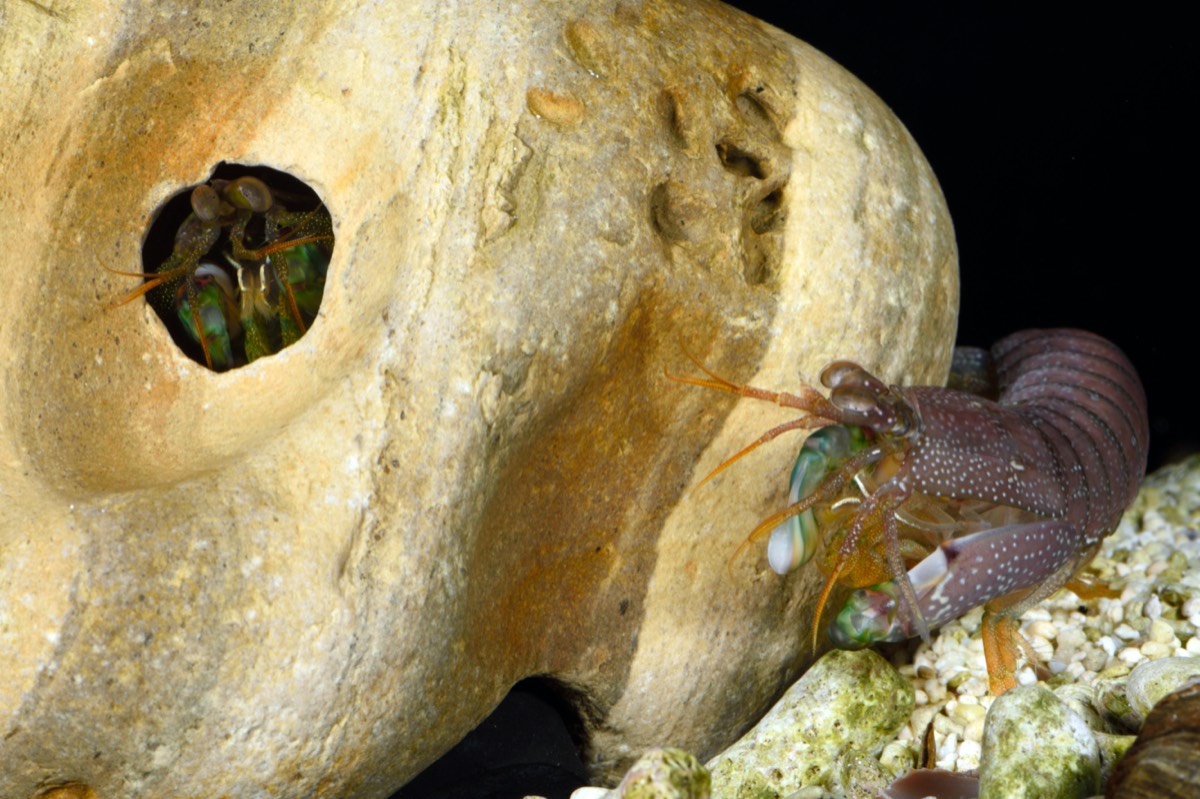
An intruder potentially assessing a burrow.
Enlarge / An intruder potentially assessing a burrow.
Roy Caldwell

Past studies have shown that mantis shrimp pick burrows whose sizes (volume) mesh well with their own body size (mass), as do hermit crabs. In the case of hermit crabs, there seems to be a tradeoff at play when it comes to resource assessment: dragging around a larger shell requires more energy but offers more protection from predators, while the reverse is true for smaller shells. Green and Harrison suggest that, when it comes to competing for a desired shell, hermit crabs may prefer shells that are the preferred size or slightly larger, while placing less value on shells that are much larger or smaller.

This would be an example of quadratic resource value assessment, in which resources are valued most highly at a certain peak level. That value decreases in either direction from that peak. In other words, there is an optimal sweet spot, or "Goldilocks zone," where an asset is deemed to be "just right" and the animal will adapt its behavior accordingly—e.g., by fighting more aggressively when such a desirable asset is contested. Green and Harrison thought a similar quadratic resource value assessment might also apply to mantis shrimp—namely, that mantis shrimp would place a higher value on burrows with an ideal volume and would be more aggressive, and more likely to win, when fighting for control of such burrows.

To test their hypothesis, the researchers conducted two sets of experiments: "choice experiments," where mantis shrimp could freely choose unoccupied burrows of varying sizes, and "staged contests," where "defending" and "intruding" mantis shrimp were randomly matched in a competition over a preferred burrow. Green and Harrison predicted that their experiments would show that competitors would fight longer and harder and would be more likely to win when their body length closely matched the volume of the contested burrow—and that these factors would decrease the further that match deviated from the ideal, in either direction.

“This study is an example of maximum effort being reserved for something that’s ‘just right.’”

The researchers built mock burrows out of clear plastic tubing with a single opening, wrapped in black vinyl, with a clear area at the top to enable them to observe what was happening inside. The mantis shrimp were collected from burrows in seagrass beds along the Caribbean coast of Panama. The researchers also videotaped the staged contests (a total of 36) and intervened if it seemed like one of the fighting shrimp was in danger of significant injury or death.

They found that, overall, the occupying mantis shrimps successfully defended their burrows from intruders in 69 percent of the fights. But those odds changed dramatically in cases where the intruding mantis shrimp were competing for burrows slightly smaller than their ideal size; intruders won 67 percent of the fights in those circumstances, typically by striking first and striking more often.

"We know that animals can assess a variety of factors, including the size of the opponent and the value of the prize, when deciding whether to fight and how hard to fight," said Green of the results. "In this case, as a smaller burrow is probably occupied by a smaller opponent, it seems mantis shrimps will compromise on the size of the home if it means an easier fight. It might be assumed that animals fight hardest for the biggest assets, but this study is an example of maximum effort being reserved for something that's 'just right.'"

There were some caveats, most notably sample-size constraints. Green and Harrison also acknowledged that the mock burrows were standardized, with set lengths and diameters, unlike naturally occurring burrows, which usually have more variable dimensions. And the smooth tubing is markedly different from the natural burrows formed in rock and rubble.

"Mantis shrimp are adept modifiers of natural burrows, using appendage strikes to widen too-narrow burrows and using rock and sand to fill in too-large burrows," they wrote. "While the individuals we tested could not widen mock burrows by striking, perhaps with more time in which to establish residency, individuals would have filled in larger mock burrows."

DOI: Animal Behavior, 2020. 10.1016/j.anbehav.2020.09.014  (About DOIs).

Listing image by Roy Caldwell

The Link Lonk


October 30, 2020 at 05:09AM
https://ift.tt/2TzhO7d

There’s no place like the perfectly sized home for the mighty mantis shrimp - Ars Technica

https://ift.tt/3eNRKhS
shrimp

To Slow Decline of Western Atlantic Bluefin Tuna, Fishery Managers Must Lower Quota - The Pew Charitable Trusts

jumi.indah.link

The population of the iconic western Atlantic bluefin tuna—the giant fish featured in fishing reality shows and at the top of many sushi menus—has declined and is experiencing overfishing, according to a new stock assessment by scientists at the International Commission for the Conservation of Atlantic Tunas (ICCAT).

When the last assessment was conducted in 2017, ICCAT’s scientists carefully explained to fishery managers that the quota the Commission was set to adopt for the western Atlantic Ocean—2,350 metric tons—would lead to a decline in the western bluefin population and would necessitate a lower quota in 2020. However, Commission members ignored that warning and raised the quota. And the latest assessment shows that the population has indeed declined—by an even greater magnitude than scientists expected. Interestingly, the decision to boost the quota didn’t even pay off economically: According to a new report from Pew, the price of bluefin has declined in recent years, likely due to a substantial oversupply in the global marketplace—and that was before the market impacts related to the ongoing COVID-19 pandemic.

Over the next eight weeks, ICCAT member governments will negotiate western bluefin quotas and decide on a quota for next year and possibly beyond. The only government proposal on the table—from the U.S.—does not specify a 2021 quota recommendation. This leaves the door open for a rollover of the existing limit of 2,350 metric tons, which the science clearly states would result in a 94% chance of overfishing that year. In fact, ICCAT’s scientists have said that any quota larger than 1,000 metric tons will lead to further decline and will require greater catch reductions in future years.

That said, a proposal from the chair of ICCAT’s subsidiary body charged with negotiating bluefin catch limits, to adopt an interim total allowable catch (TAC) for 2021, has at least a 50% chance of ending and preventing overfishing. Although that’s not a high probability of success, it is significantly better than the 6% chance under a quota rollover scenario. At a time when negotiations are electronic versus in person, and hammering out disagreements is much harder than in years past, the chair’s proposal represents a strong compromise. Importantly, it also meets the minimum threshold for recovery under U.S. law for managing fisheries, something the U.S. proposal does not guarantee.

The U.S., Canada, and Japan are the primary fishers of and markets for western Atlantic bluefin. It is critical that these countries embrace their roles as ICCAT leaders and support the chair’s proposal to cut the TAC and end overfishing. For the U.S., that would mean withdrawing its proposal.

If they don’t, other ICCAT parties may need to step up as voices for conservation to persuade the Commission to adopt the chair’s sensible plan.

ICCAT must stop raising quotas at the slightest sign of good news, as it did in 2017, and opposing decreases when the news is unequivocally bad. Instead, the Commission should focus managers’ and scientists’ attention on advancing harvest strategies—a more stable, predictable, and science-based management approach that would significantly increase the likelihood of this population rebuilding and stabilizing at a sustainable level.

Western Atlantic bluefin is worth at least $20 million to fishing operations and is a vital part of the ocean ecosystem. ICCAT must move forward to safeguard the stock in 2021 and into the future.

Grantly Galland works on The Pew Charitable Trusts’ international fisheries project.

The Link Lonk


October 30, 2020 at 03:34AM
https://ift.tt/34Cc8jk

To Slow Decline of Western Atlantic Bluefin Tuna, Fishery Managers Must Lower Quota - The Pew Charitable Trusts

https://ift.tt/2NKNaVQ
Tuna

Hey There, Big Tuna. A Monster 360-Pound Fish Was Netted in Orange County - NBC Southern California

jumi.indah.link

This certainly deserves the buggy-eyed emoji.

A 361-pound tuna fish was captured off the Orange County coast, becoming the largest captured off fishing fleet vessels since 1958, according to Newport Landing Sportfishing in Newport Beach.

The big tuna was caught sometime between Sunday and Monday afternoon on an overnight trip.

A whopping 11 Bluefin Tuna were caught aboard the vessel hosting 24 guests

Even the smallest weighed what a full grown adult would -- weights ranged from 160 to 361 pounds.

Giant Tuna Sets Record in Orange County

The biggest tuna was professionally weighed, Newport Landing Sportfishing in Newport Beach said.

The Link Lonk


October 29, 2020 at 08:52AM
https://ift.tt/3kGOJmu

Hey There, Big Tuna. A Monster 360-Pound Fish Was Netted in Orange County - NBC Southern California

https://ift.tt/2NKNaVQ
Tuna

Tuna catch - South Jetty

jumi.indah.link

Cole Warner of Argo, Kan., brought in this 88-pound yellowfin tuna from an offshore tip on Friday, Oct. 16. Warner was aboard the Dolphin out of Dolphin Dock on a 60-hour trip.


The full version of this story will be available to all readers after 2 weeks.

Full versions of news stories from the most recent 2 weeks are available to online subscribers only. Access to full versions of news stories from issues older than 2 weeks are available to all readers for free in our archive of all issues.

Not an online subscriber yet? Sign Up Here
Purchase this online single issue Purchase Now

The Link Lonk


October 29, 2020 at 01:14AM
https://ift.tt/2HAF2rv

Tuna catch - South Jetty

https://ift.tt/2NKNaVQ
Tuna

Breaking: Deaths of 2 more Indonesian crew uncovered on board Chinese tuna fleet - Mongabay.com

jumi.indah.link
  • Official documents show the deaths of two Indonesian crew members of a Chinese fishing fleet went unreported amid an outcry over the deaths of four other men and allegations of forced labor and illegal fishing.
  • Saleh Anakota, 22, died on Aug. 10, three months after the deaths of four of his compatriots aboard the same boat, the Long Xing 629, drew international condemnation; Rudi Ardianto, 30, died on Aug. 8 aboard another boat, the Tian Xiang 16, in the same fleet.
  • Both deaths, attributed to an unknown “sickness,” are mentioned in Indonesian Foreign Ministry documents seen by Mongabay.
  • The documents also show Indonesia and China are working to bring home 155 Indonesian crew members from the Long Xing 629 and 11 other vessels owned by Dalian Ocean Fishing (DOF), a major Chinese tuna-fishing company that supplies Japanese and Chinese markets.

Another Indonesian crew member has died aboard the Long Xing 629, a Chinese vessel alleged to have used forced labor to engage in illegal fishing, including shark finning, Mongabay has learned.

The man, 22-year-old Saleh Anakota, passed away on Aug. 10, three months after the boat became the focus of an international outcry over the deaths of four other Indonesian crew, who fell sick from an unknown illness after allegedly being physically abused and overworked by senior officers.

News of Saleh’s death, not reported in the media until now, has emerged as Indonesia quietly works to repatriate 155 of its citizens serving as crew aboard the Long Xing 629 and 11 other vessels owned by China’s Dalian Ocean Fishing (DOF), according to documents from the Indonesian Ministry of Foreign Affairs seen by Mongabay. The company is a major supplier of sashimi-grade tuna to Japanese and Chinese markets.

In addition to Saleh, a 30-year-old crew member named Rudi Ardianto died on Aug. 8 aboard another DOF ship, the Tian Xiang 16, the documents show.

Both died from “sickness,” according to Judha Nugraha, the ministry’s director-general of citizen protection.

“There must be a further examination to determine the cause of the sickness,” Judha told Mongabay in a text message on Oct. 27.

“Indonesia and China have agreed on a law enforcement partnership to bring the responsible parties to the court,” he added. “The partnership is done through MLA.”

An MLA is a mutual legal assistance treaty, or an agreement between countries to share information on criminal matters. Retno Marsudi, Indonesia’s foreign minister, has been trying to convince China to sign an MLA with Indonesia since at least Aug. 21, when she reportedly met with her Chinese counterpart in Sanya, a coastal city on China’s southern Hainan Island, to address allegations of mistreatment of crew aboard Chinese fishing boats in several cases that had emerged since the beginning of the year.

The Long Xing 629. Image courtesy of the WCPFC.

Indonesian crew members repatriated from the boat in May told Advocates for Public Interest Law (APIL), a group in South Korea, where the survivors were quarantined as a precaution against COVID-19 before being sent back to Indonesia, that they had suffered from brutal working conditions and unhealthy living conditions.

“They drank salty water converted from sea water while their Chinese counterparts drank bottled water,” the report says. “The crew members claimed that drinking the salty water made their colleagues sick leading to death.”

It adds, “They were physically assaulted by some of the Chinese crew. Moreover, the crew stayed onboard for 13 months, never disembarking at a port. Multiple transshipments at sea allowed the continued operation of the ship for a prolonged period.”

Crew members also said the captain confiscated their passports, made them work an average of 18 hours a day and directed them to use specialized gear to catch and fin a large number of sharks, including endangered species protected under the Convention on International Trade in Endangered Species (CITES).

Photos and videos taken by crew aboard the Long Xing 629 show them finning shortfin mako sharks, scalloped hammerhead sharks and great white sharks. Image courtesy of Environmental Justice Foundation.

The reason for the repatriations of the 155 crew members is unclear. Neither DOF nor the Chinese Embassy in Jakarta answered phone calls on Oct. 29, and the foreign ministry’s Judha did not respond to questions about why the repatriations were taking place.

However, a Chinese website that compiles court verdicts shows DOF has been named in more than a dozen lawsuits filed this year against it and its sister companies alleging a failure to repay loans. Courts in several of these cases ordered assets belonging to DOF to be frozen.

Tens of thousands of people from Indonesia, which with a population of 260 million is the world’s fourth-most populous country, work as crew aboard coastal and distant-water fishing vessels from other countries. They mostly come from Indonesia’s main central island of Java, the most densely populated major island in the world, but increasingly hail from around the archipelago nation. Saleh and Rudi, the two men who died in August, were from West Java and Maluku provinces.

Labor rights campaigners contacted by Mongabay said they were trying to confirm how many of the 155 men, most of whom are in their twenties, had already arrived back in Indonesia. Some of the men, they said, appeared to be stuck in Senegal. A spokesman for the Wisma Atlet COVID-19 quarantine center in Jakarta would not say whether any of the fishers were being housed there.

The foreign ministry documents say two DOF boats, the Long Xing 601 and Long Xing 610, are now on their way to Bitung, a port city on the northern coast of the Indonesian island of Sulawesi, and are expected to arrive on Nov. 5. It’s not clear whether they’re bringing back crew members or the bodies of the deceased, or if they have another purpose.

Ilyas Pangestu, the chairman of the Indonesian Fisheries Workers Union (SPPI), which is advocating for the men repatriated in May, told Mongabay that China should protect the rights of migrant workers aboard vessels carrying its flag.

Indonesian authorities are already pursuing human trafficking cases against employees of at least three labor recruitment companies in Indonesia that sent abroad the crew members caught up in the scandal that emerged around the Long Xing 629 earlier this year. The APIL report documented withholding, deduction and non-payment of wages — indicators of forced labor, according to the International Labour Organization — among the men who returned to Indonesia in May.

Besides the Long Xing 629 case, recruiters in at least three other cases involving Chinese distant-water fishing boats have been charged with human trafficking by Indonesian authorities this year.

Banner: A scalloped hammerhead shark. Image by Rhett A. Butler/Mongabay.

FEEDBACK: Use this form to send a message to the author of this post. If you want to post a public comment, you can do that at the bottom of the page.

, , , , , , , , , , , ,
The Link Lonk


October 29, 2020 at 12:50PM
https://ift.tt/3e8rboc

Breaking: Deaths of 2 more Indonesian crew uncovered on board Chinese tuna fleet - Mongabay.com

https://ift.tt/2NKNaVQ
Tuna

Wednesday, October 28, 2020

Latest Angry Crab Shack now open in the San Tan Valley - Your Valley

jumi.indah.link

A favorite seafood eatery has made its way to San Tan Valley near Queen Creek.

In seven years, the Angry Crab Shack has grown to 11 locations in Arizona, including six owned-and operated restaurants in the Valley. The Mesa-based company has another restaurant in Orange Beach, Florida, and has plans to open other franchised operations in Nevada and areas in the South.

Angry Crab Shack specializes in seafood and boils with Asian and Cajun flavors. Ron Lou founded Angry Crab Shack in 2013 after years of building a reputation as a successful Valley restaurateur with his acclaimed Chinese seafood restaurant C-fu.

“We are looking forward to sharing our fun and unforgettable dining experience with the San Tan Valley community,” Mr. Lou said. “We love seeing families and groups of friends enjoy our fresh, delicious seafood while engaging with our one-of-a-kind restaurant.”

Mr. Lou’s enthusiasm is not meant to minimize the COVID-19 pandemic. In fact, the company has remained steady, opened new revenue streams and is committed to keeping its restaurant staff members safe.

Andy Diamond, chief financial officer for Angry Crab Shack, said the pandemic has proven to be a double-edged sword. In July, the company closed its dining rooms as precaution amid a spike in COVID cases. At the same time, the company took the opportunity to live with the new normal and delved into take-out and delivery service.

Diamond said that shift in dining has inspired the company to think of ways to properly package food so it gets to customers’ homes almost the way they would at the restaurant.

Even with dining rooms reopened, Diamond said many old and new customers are happy to keep ordering online or doing pick-up. Meanwhile,  managers of the company-owned and -operated Angry Crab Shacks, as well as franchisees, are making sure employees stay safe with gloves, masks, social distancing and temperature checks. Guests also have their temperatures checked before entering the dining room.

The San Tan Valley restaurant will feature Angry Crab Shack’s signature menu of Cajun seafood boils, as well as seafood-focused appetizers, sandwiches, soups and salads. The restaurants source lobster from the East Coast, Dungeness crab from the Pacific Northwest, King and Snow Crab from Alaska, and crawfish from the Gulf of Mexico

The family-friendly San Tan Valley restaurant has a similar look and feel to other Angry Crab Shack locations. It incorporates its well-known, vibrant décor that includes live fish tanks, ocean life decorations and wood-boarded walls that guests can sign.

The restaurant is  at 1749 W. Hunt Highway and is open Sunday through Thursday from 11 a.m. to 9 p.m., and Friday to Saturday 11 a.m. to 10 p.m. for dine-in, carryout and delivery. To place an order for pick-up, call the restaurant at 480-608-2722, or to place a delivery order online via DoorDash.

The Link Lonk


October 29, 2020 at 06:06AM
https://ift.tt/2TA1zac

Latest Angry Crab Shack now open in the San Tan Valley - Your Valley

https://ift.tt/2MkGRbk
Crab

Corey Arnold's best shot: a horse and a cat go fishing for crab - The Guardian

jumi.indah.link

This was shot in my third season crab fishing on a vessel called Rollo. King crab season in the Bering Sea, off Alaska, usually starts mid-October and lasts for several weeks, but it can be as little as one week – it depends on weather, luck and skill. When the season is finished, everyone goes in to Dutch Harbor and waits to offload their catch. There can be about 350 other boats filled up with crab. Sometimes you queue for eight days.

Everyone looks forward to Halloween. You get a bunch of crabbers in a bar and it gets pretty crazy. I’d bought this horse-head costume in advance and, as we were cruising in to Dutch Harbor, my friend Matthew and I were trying out costumes. I took some pictures of him wearing the mask, then my cat came walking by and Matthew grabbed her.

Kitty was seven months old. The captain had cats on the boat and I had decided to get one myself. I had gone to the pound looking for one with a mellow temperament, because I knew that, what with all the pots banging around and storms at sea, I didn’t want a pet who would be scared and hiding all the time. I opened the cage doors and most of the cats were pinned against the backs of the cages. But then I opened Kitty’s – she never got a name, just Kitty – and she was just standing there, her tail flopping back and forth. I threw a ball and she came leaping out. I was like: “OK, this is the cat for me.”

Kitty was so fearless. She would saunter out in the middle of storms or sit on the back deck as we were trying to stack up an 800-pound crab pot. Several times, I had to yell up at the crane operator, to let him know Kitty was there, looking up at a pot that was about to drop on her head. She was always trying to stalk seagulls but she was too small – they were way bigger than her. Life on a commercial boat didn’t offer her much chance of longevity so after two seasons I retired her and she’s lived at my home ever since. She’s almost 15 now.

I overlooked this image for a couple of years. I thought it was just a joke. Then I came across it one day. For me, it says something about commercial fishing: the work is so gruelling and dangerous that there is a lot of joking around, to blow off steam.

I grew up in southern California on the ocean. My dad got me into sport fishing when I was still in diapers. When I was 19, I drove up to Alaska with a friend to search for a fishing job. I had been crabbing for about a year and a half before we ended up on the reality show Deadliest Catch. I remember being a little disappointed they didn’t bring us back the next year but I’m relieved now. The fame got to the folks who kept doing it.

When you’re crabbing you’re facing the full force of nature, risking injury and death. I’m known for photography but fishing is where I’m in my element. It is hard on your body, the weather is stressful, and there can be all kinds of haywire dangerous stuff happening. Today’s digital world has us so out of our bodies, but here you’re so present, so alive.

I’ve been in situations where the boat is getting covered in ice and it’s night and I’m on a stack of crab pots as the webbing on them freezes and everything is slippery. The last Bering Sea trip I went on, I snuck out to take photos of really big seas. A huge wave came over and I was swimming underwater for a minute. My entire camera, even through a plastic bag, was soaked. In rough weather, you need all your senses. Having one eye closed and the other looking through a camera is pretty dangerous.

The first time I exhibited this was at a gallery in Chicago. Everyone paused at that photo. Most said they thought it was fake or Photoshopped. I think it works because of the intense, startled look on both the horse’s and the cat’s face. There’s a mystery you want to solve. “Why would this be happening?” Everyone wants to know.

Corey Arnold’s CV

Corey Arnold

Born: La Jolla, California, 1976.

Trained: Academy of Art, University, San Francisco.

Influences: Sally Mann, Martin Parr, Joel Sternfeld.

High point: “National Geographic cover story, October 2016.”

Low point: “Dropping an entire backpack of photo equipment off a cliff in Zion national park.”

Top tip: “Find a project you are passionate about and dedicate years to making it perfect.”

The Link Lonk


October 28, 2020 at 09:40PM
https://ift.tt/3e2smFB

Corey Arnold's best shot: a horse and a cat go fishing for crab - The Guardian

https://ift.tt/2MkGRbk
Crab

Featured Post

Windjammer Days 3rd annual Crab Cake Cook-off - Boothbay Register

jumi.indah.link Boothbay Harbor Inn hosted the third annual Crab Cake Cook-Off June 28 for the long awaited and revived Windjammer Days Fe...

Popular Posts