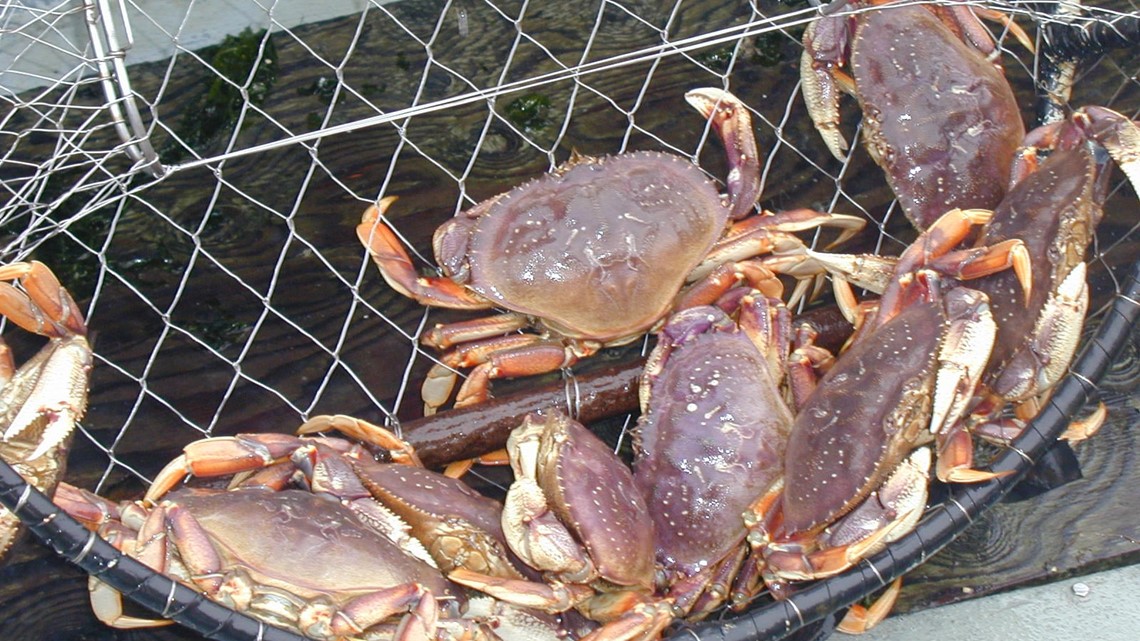
The crab was caught by the tribe from Dec. 23-28 and sold to food processors in Washington.
SEATTLE — Nearly 29 tons of Dungeness crab is being voluntarily recalled by the Quinault Tribe. The recall affects live and uneviscerated Dungeness crab.
The crabs are being recalled due to possible elevated marine toxin levels. The toxin is called domoic acid, which can be harmful to people if the contaminated shellfish are consumed.
Symptoms can include vomiting, nausea, diarrhea, and abdominal cramps, which can start within 24 hours of consumption.
The crab was caught by the tribe from Dec. 23-28 and sold to food processors in Washington. Everyone who purchased the crabs is being advised to destroy the product and contact the place where it was purchased.
Closures are currently in effect on the Washington coast for recreational Dungeness crab fisheries, due to elevated marine toxin levels.
On Dec. 28, 2020, the Washington State Department of Fish and Wildlife announced closures for the Washington coast to include coast waters between Point Chehalis to the Queets River. Officials said previous closures remain in effect for Marine Area 1 (IIwaco) and Marine Area 2 (Grays Harbor and Willapa Bay).
Shellfish managers expanded the closures after testing showed domoic acid levels in crab for these waters exceeded standards for safe consumption.
Shrimp is Ecuador's second largest export, making the sector a key target for extortion.
The persistent robbery, extortion, assault, and even murder of shrimp farm workers by armed gangs in Ecuador has led the shrimp sector to once more demand gun reforms, in a new attempt to challenge the criminal groups feeding off this lucrative industry.
In December, representatives of Ecuador’s National Chamber of Aquaculture (Cámara Nacional de Acuacultura —CNA) stated in a press conference that in the last three years organized crime groups have murdered seven shrimp farmers, injured another 60, and stolen shrimp and equipment worth over $2.5 million, according to a CNA press release.
Since authorities have proven unable to protect shrimp sector workers, CNA representatives called on Ecuador’s government and National Assembly to relax the Law on Arms, Ammunition, Explosives, and Accessories and lower the ICE Special Consumption Tax, which charges a 300 percent tax on firearm and ammunition purchases, to facilitate shrimp workers acquiring guns to defend themselves.
For years, armed criminals on boats have been hijacking shrimp vessels at sea and stealing their catch, equipment, and engines, while vehicles carrying shrimp on land have been stopped and robbed at gunpoint, according to a January article by El Universo. The critical areas have been the Gulf of Guayaquil and the Jambelí Archipelago, yet small shrimp farms have also been raided by armed thieves, while gangs often extort shrimp farm workers for monthly payments.
In effect, the entire shrimp sector is under attack, which forces the industry to invest $60 million annually to protect its businesses. Yet while surveillance cameras and private security companies have some success, small- and medium- sized businesses often cannot afford them. Adding insult to injury, stolen merchandise is often sold back to the victims at a premium.
InSight Crime Analysis
Across Latin America, victims of insecurity and criminal violence have understandably often invoked self-protection when demanding looser gun laws. Yet from Brazil to Panama and Honduras to Peru, evidence suggests weaker gun laws often lead to increased violence, with criminals amassing legal arsenals.
A 2015 report by the United Nations Office of Drugs and Crime (UNODC) already found that firearms trafficked into Ecuador arm private security companies and shrimp farms as often as they do domestic criminals and while the ongoing robberies must be better addressed, reversing the trend of falling firearm seizures in Ecuador is unlikely to be an effective solution.
Greater government action should theoretically be the way forward, yet despite Ecuador’s shrimp industry being the world’s second-largest and shrimp being the nation’s second-largest export, law enforcement has been lacking. Since 2016, Ecuador’s Navy and Coast Guard have implemented the “Safe Routes” (“Rutas Seguras”) plan, maintaining a number of patrolled maritime corridors through which fishermen can move safely.
According to the CNA’s website, there are currently 12 Safe Routes listed for Jambelí Archipelago and 24 listed for the Gulf of Guayaquil. Interested parties may secure a Coast Guard escort by contacting the listed number and providing details as to when and where they require the escort. Yet while authorities claim the routes have been highly effective, with robberies dramatically lowered, fishermen in nearby rivers have complained about not receiving protection.
This underlines the key problem: The Navy is unable to guarantee security outside of limited passageways. Nor has the plan ended violence and robbery against the shrimp sector. Additionally, in 2019, when Ecuador’s shrimp exports reached a record $3.65 billion, according to CNA statistics, CNA representatives were granted a meeting to discuss the issue with Defense Minister Oswaldo Jarrín.
Any proposed measures were void in May 2020, however, when security escorts were stopped and Navy ships temporarily grounded after it was discovered Ecuador’s Armed Forces had not renewed their insurance coverage. Delayed payment of the final installment of $1.1 million was blamed on the Ministry of Finance, as well as to an overall cut in the Armed Forces budget.
Occurring right as a Chinese fishing fleet threatened Ecuadorian maritime sovereignty near the Galápagos Islands, the fiasco stopped patrols for several weeks before payment was made and the “Safe Routes” plan resumed. Nonetheless, the shrimp sector’s literal call to arms indicates the problem remains unsolved.
Although you don’t know me, here’s a fun riddle that could apply to lots of people, and maybe even you:
“Guess what these four things have in common for the author of this article: blueberries, shrimp, and the services of Raul (my local auto body shop owner) and Maria (one of our housekeepers).”
Before you answer, assume that I like blueberries, shrimp, impeccable dent repair and an immaculately tidy, close to hygienic house with my clothes freshly laundered and folded, all by someone other than me.
What these things have in common, at least for me, is that they are all luxuries I would have been reluctant to buy in the US because they were too expensive. Either that, or I would have bought them anyway, but then experienced at least a tinge of remorse, which in turn, would have diminished my happiness, which was supposedly the purpose of buying them in the first place.
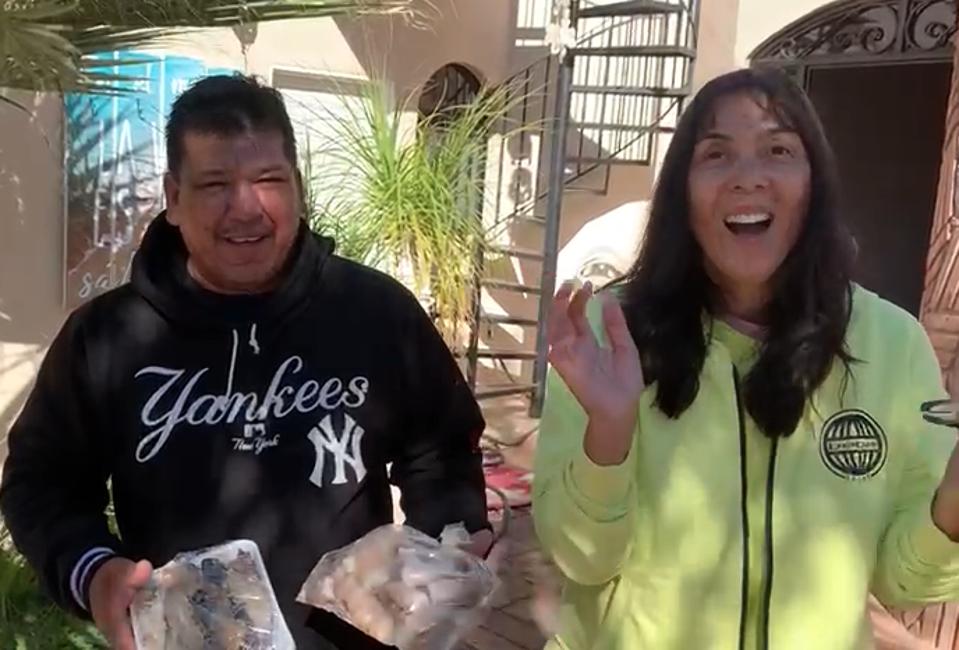
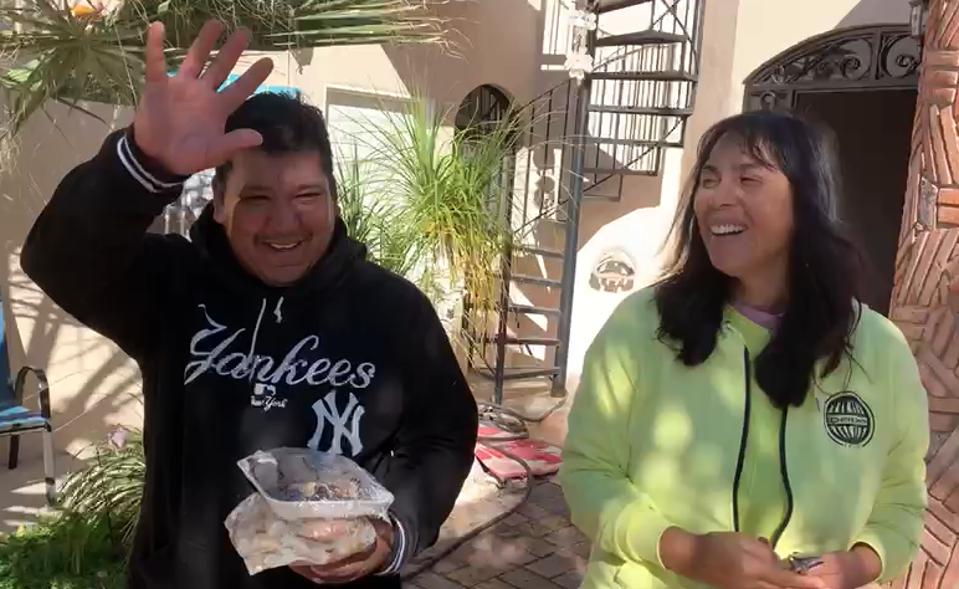
Jet Metier with seafood vendor in Mexico
Chuck Bolotin
None of that is true now that we live here in Mexico.
I buy all these things and more here in Mexico with reckless abandon, a clear and happy conscience and a good amount of joie de vie.
MORE FOR YOU
Put simply, living here in Mexico takes the edge off lots of things, including the stress of buying otherwise luxury items and services. Let me give you some accordant examples.
Like lots of people, I like to eat blueberries. Perhaps you do, too. Let’s say you’re in the US and would like to buy some. How much would you buy and how much would it cost you?
I remember buying an amount so small from our local US supermarket that it looked like the clear plastic package was about three inches by three inches side to side and a depth of about one blueberry deep. In some places, I could actually see right through the package to the other side. I probably could have counted each blueberry without opening the package and it would have taken me perhaps 15 seconds.
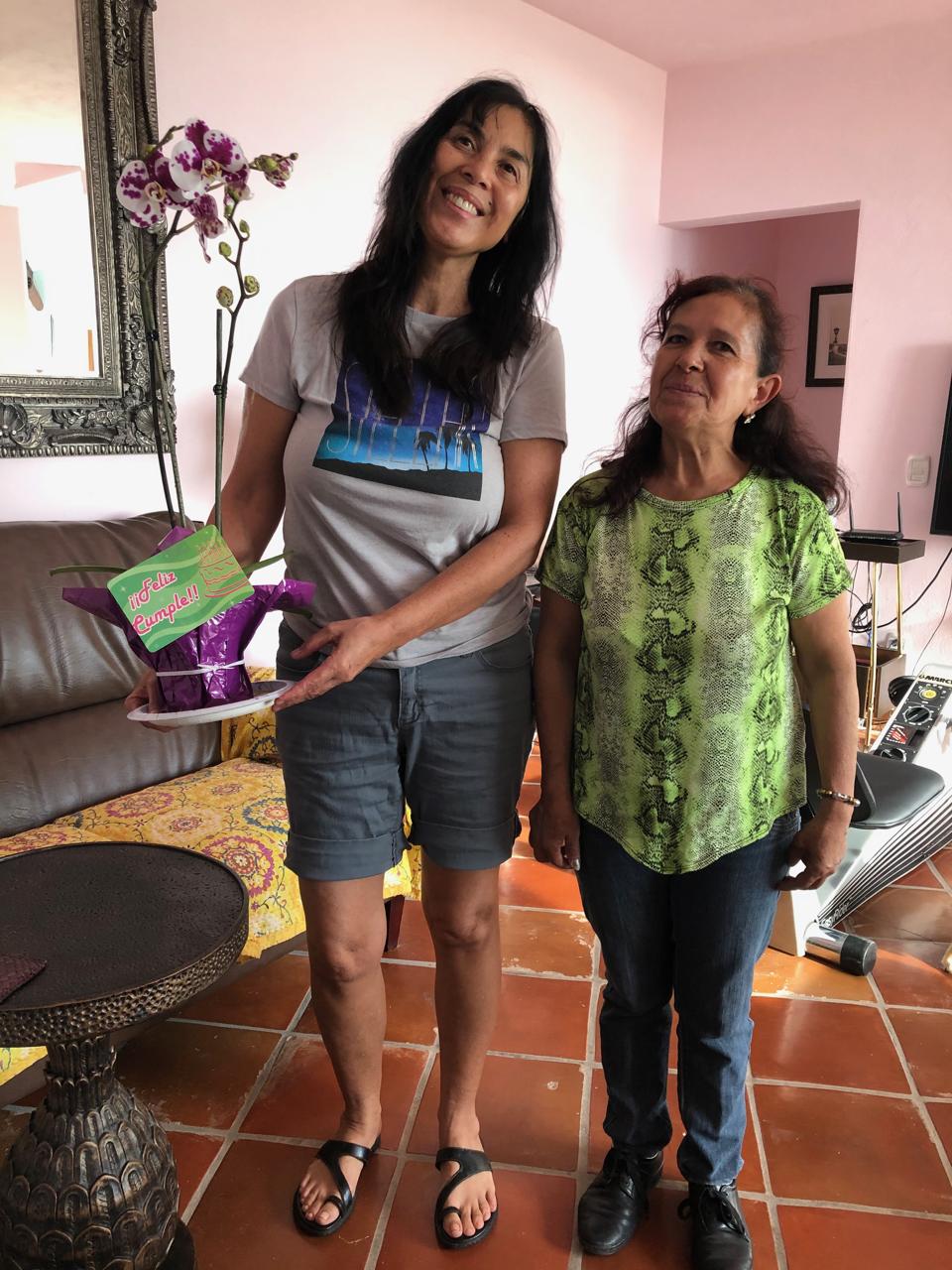
Jet Metier with "Maria" in Mexico
Chuck Bolotin
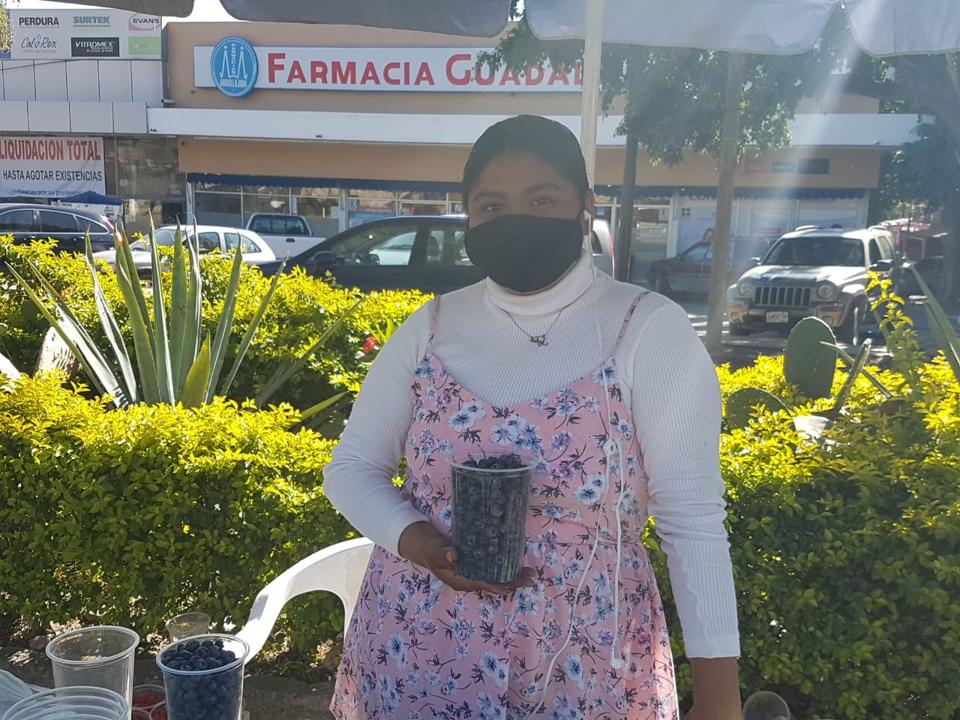
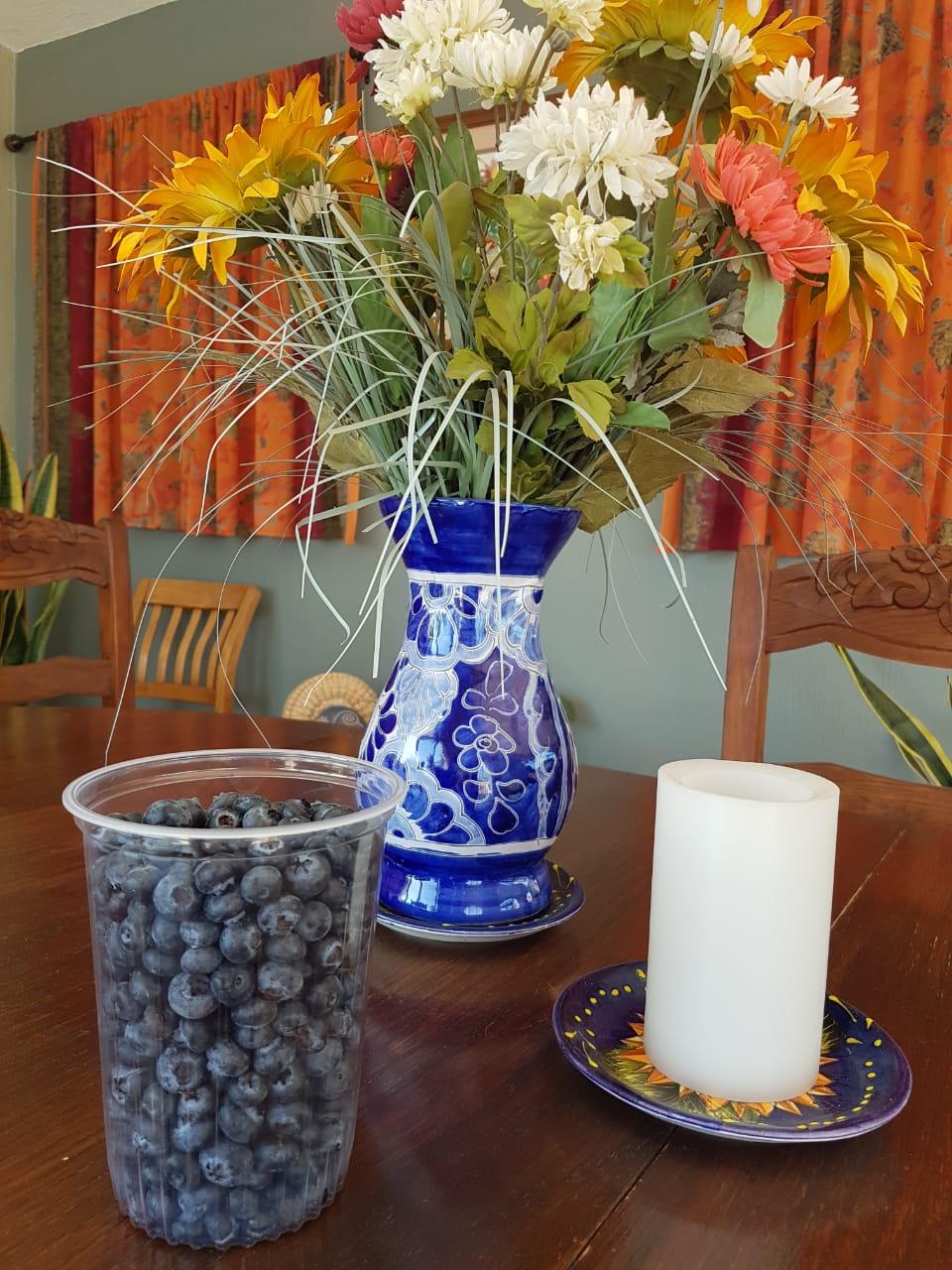
In contrast, over here in Mexico, I pay the equivalent of less than USD $4 for a liter (about 34 ounces; more than a quart) from one of several vendors on the street. Of course, at that price, I don’t just buy one liter. How many do I buy? Let’s just say that my levels of copper, beta-carotene, folate, choline, vitamins A and E, and manganese are more than adequate.
Let’s move on to shrimp. I grew up in California, as a child probably not quite reaching the level of middle-class. As such, for our family, shrimp was a luxury to be eaten effectively never and only enjoyed by other, “wealthy” people. Well, here in Mexico by all relevant evidence, it looks like I’ve arrived in the wealthy class, because the price of shrimp here (we live up in the mountains, five hours by car from the ocean) is substantially less than half of what it is in the US. I had eaten shrimp so rarely before moving here that I never really even knew before moving here if I even liked shrimp. Now, I’ve had it so often I can make a relatively good case for the best ways to prepare it.
I still eat way more blueberries than shrimp, because I still like blueberries more. Perhaps you would indulge in different culinary pursuits, but the overall point is
Liter of blueberries in plastic container
Bryan Clark
that, here in Mexico, items we normally associate with luxury are so reasonably priced, it’s like you’ve been magically transported to an alternative reality where either everything is half off (or more) or your income has been wondrously doubled by the Happiness Wizard, without you doing anything other than changing your geography. You’re the same person; you’re just eating a good amount of blueberries and shrimp, and you’re enjoying it way more.
Let’s move on to something that is a bit less of a luxury and a whole lot less fun— getting a dent repaired on your car. When I lived in Arizona, just before moving here, I backed into a wall at low speed, causing a relatively small indentation in the rear end of my car.
When I write “relatively small” I’m talking about the size of the dent, as opposed to the cost to repair it.
I forgot exactly how much the estimates were, but I remember them to be around $1,100 or $1,300. One of the reasons I don’t remember how much it was is that I didn’t get it repaired in Arizona. It made me a bit more than annoyed to pay that much for what should have been a minor repair. Also, I was moving to Mexico soon, so I could see what the repair would cost there.
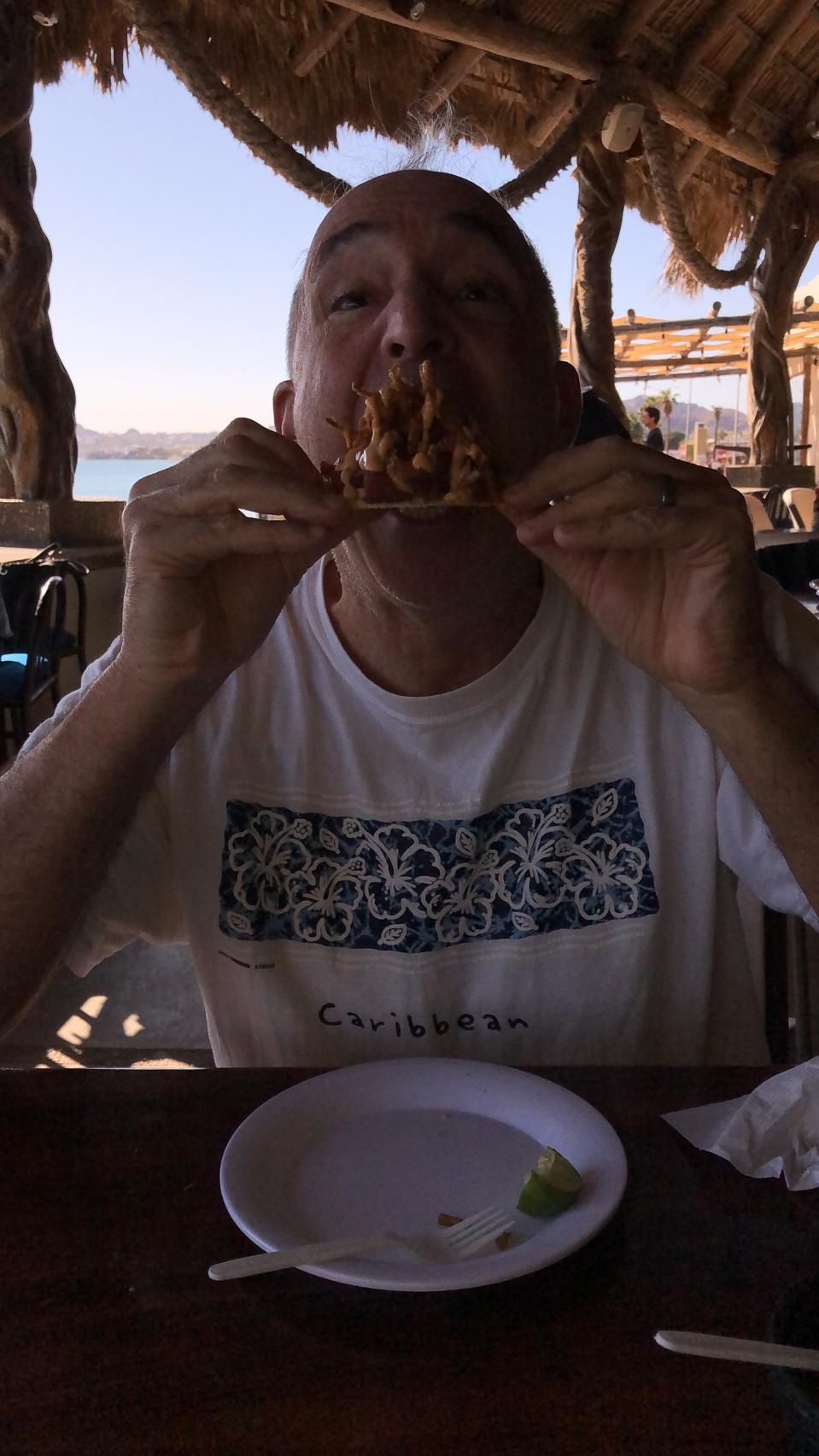
Author indulging in seafood tostada in Mexico restaurant.
Jet Metier
After bringing that car to Mexico, I visited Raul, the sole proprietor of a local body shop. After rousting Raul out of his hammock and paying him the equivalent of $60, I couldn’t even tell you where the repair was; it was that good. Result: savings of more than $1,000 in my pocket, which is the equivalent of 300 liters or 111,000 blueberries (I did the math) — enough to fill up my bathtub here in Mexico so high I could literally bathe in blueberries with the savings (while eating shrimp!).
But even more importantly, I was able to replace the feelings I would experience in the US fearing or needing body work (somewhat equivalent to the seven stages of grief— shock and denial; pain and guilt; anger and bargaining; depression, etc.) with the following three stages in Mexico: 1) nonchalance; 2) followed by mild amusement; 3) followed by a good amount of happiness and gratitude that I wasn’t feeling what I would feel in the US.
Speaking of gratitude, this brings me to our housekeeper, who I’ll call Maria, whose services are a luxury I would not have indulged in at least as often when living in the US. As I’ve written before, Maria is just like a mother who takes care of you, but without the guilt. In addition to treating Maria as best we know how (which is just common human decency and being able to treat people well is one of our joys in living here in Mexico) to do a good amount of our house chores, all we have to do is pay Maria, which makes Maria very happy. And because the going wage for Maria is roughly 10% to 20% of what we would pay in the US, we can easily afford to keep Maria employed while giving my wife and me lots of free time that otherwise would
Seafood vendor Manuel with Jet Metier
Chuck Bolotin
have been spent mopping floors, scrubbing toilets, folding clothes, and lots of other related chores we no longer have to do, so instead, we can do other things we enjoy more.
So, what’s the bottom line? Here in Mexico, the blueberry and shrimp vendors are happy, Raul is happy, Maria is happy, and my wife and me are happy… and less stressed. I’d like to tell you more, but I can hear that the blender has just stopped, and my smoothie will soon be ready.
Yum…
Full disclosure: the author owns a moving company, Best Mexico Movers. This could have influenced his view of blueberries, shrimp, car repair, and other topics related to living in Mexico, but he doesn’t think so.
The Mighty Crab is now open in Texarkana serving boiled seafood and more.
The Mighty Crab Texarkana is located in the building that previously held Hopkins Icehouse on Gibson Ln.
The Mighty Crab offers seafood boils offering items such as shrimp, crab, lobster, oysters, potatoes, and corn. Fried baskets of shrimp, tilapia, catfish, and oysters are also available.
Advertisement
The Mighty Crab is located at 4030 Gibson Ln, Texarkana, TX and opens at 11 a.m. daily.
We have a very, er, specific New Year's Eve food tradition in my household.
It's an elaborate shrimp tree, and my mother and I spend hours constructing it each year. There's the day-of, panicked search for the correctly shaped and perfectly sized foam cone, which somehow always gets tossed away during the year prior. There's the painstaking affixing of curly kale leaves to said foam cone (once procured), in the style of a full Christmas tree. There's the careful preparation of a perfectly seasoned cocktail sauce. And then, just before our New Year's Eve party starts, there's the pinning of each individual shrimp to the tree, using colorful toothpicks, to look like a wrap-around garland.
Advertisement:
While I'd love to say this is a regional Northern California tradition, honed by many generations, I'm pretty sure it's something we just decided to serve one year and loved.
But shrimp trees aside, there are lots of edible traditions around the holiday of New Year's hailing from all over the world. While this list is so far from comprehensive it might as well just say "shrimp tree" for every entry, we've culled together a handful of common New Year's foods eaten around the world, for your reading pleasure — don't forget to add to our list in the comments, please!
In the Netherlands, oliebollen — which literally means "oil balls" — are consumed on New Year's Eve, which purportedly began as a way to line the stomach with oil as a slick shield against the sword attack of a mythical (evil) goddess. If that doesn't sound appealing, then you haven't seen oliebollen, which are delicious donuts.
3. Japan
If you're in Japan on New Year's Eve, then you might find yourself enjoying a bowl of toshikoshi soba, or "year-end noodles," which are made of buckwheat and lengthier-than-typical soba to symbolize longevity.
4. United States
In the South, New Year's Day celebrators eat Hoppin' John, a meal of black-eyed peas, ham hock and rice (sometimes with greens, too). It's believed to beckon wealth and good luck in the year to come.
Advertisement:
5. Germany and Austria
Marzipan pigs — aka, almond paste and sugar shaped into hogs — are gifted around New Year's in Germany and Austria to symbolize good fortune.
In Turkey, some smash pomegranates in the doorways of their homes. As the tradition goes, the number of seeds that fly out predict how much good fortune you'll have in the coming year.
Vasilopita cake, full of warming spices, is typically baked on Jan. 1 in Greece. Sometimes, a coin (or other trinket of some sort) is hidden inside for one lucky guest to find.
11. Russia
On New Year's Eve in Russia, children get a visit from Father Frost, who brings gifts while they sleep. (No reindeer come with this bearded gift-giver, but Father Frost's granddaughter, Snegourochka is there to assist.) The real presents, though, are the eats: pelmenyi with sour cream, pickled herring, mayo-slicked Olivier salad of boiled potatoes and eggs, and of course caviar and plenty of vodka.
12. Scotland
In addition to the tradition in many English-speaking countries of singing "Auld Lang Syne," many folks in Scotland follow the practice of the "first footing," or "first foot" in the house: apparently, an omen of good luck for the new year is if the first person to step foot in the house after midnight is a dark-haired man (this goes back to days of Viking invasions), bringing, among other symbolic items, shortbread, salt, and whiskey.
Advertisement:
13. Chile
Chileans also partake in the Spanish grape-popping and Italian lentil-munching traditions. In Talca, Chile, locals have developed a newer New Year's Eve practice of visiting departed loved ones at a cemetery after midnight mass, where they listen to music and light candles in remembrance.
14. Armenia
Nothing says "good luck in the new year" like bread, according to some Armenian families, who bake a large, flat loaf known as tarehats, darin, or gata. A coin or a single walnut is baked inside the bread, and whichever member of the family finds the prize trinket in their piece is expected to have the best luck that year.
15. Denmark
No purchased noise-makers needed in Denmark — though you may want to lock the kitchen cabinets if you love your dinnerware: There is a tradition of smashing plates against the doors of your friends and neighbors. (Apparently, a pile of china at your doorstep on New Year's Day is a sign you're beloved). If you prefer to save your plates for food, many Danes also jump off chairs to ensure good luck for the next year.